
Simply put: You hear more about security problems in Windows because it is the biggest target — not because it is inherently less secure.
Here are the real reasons:
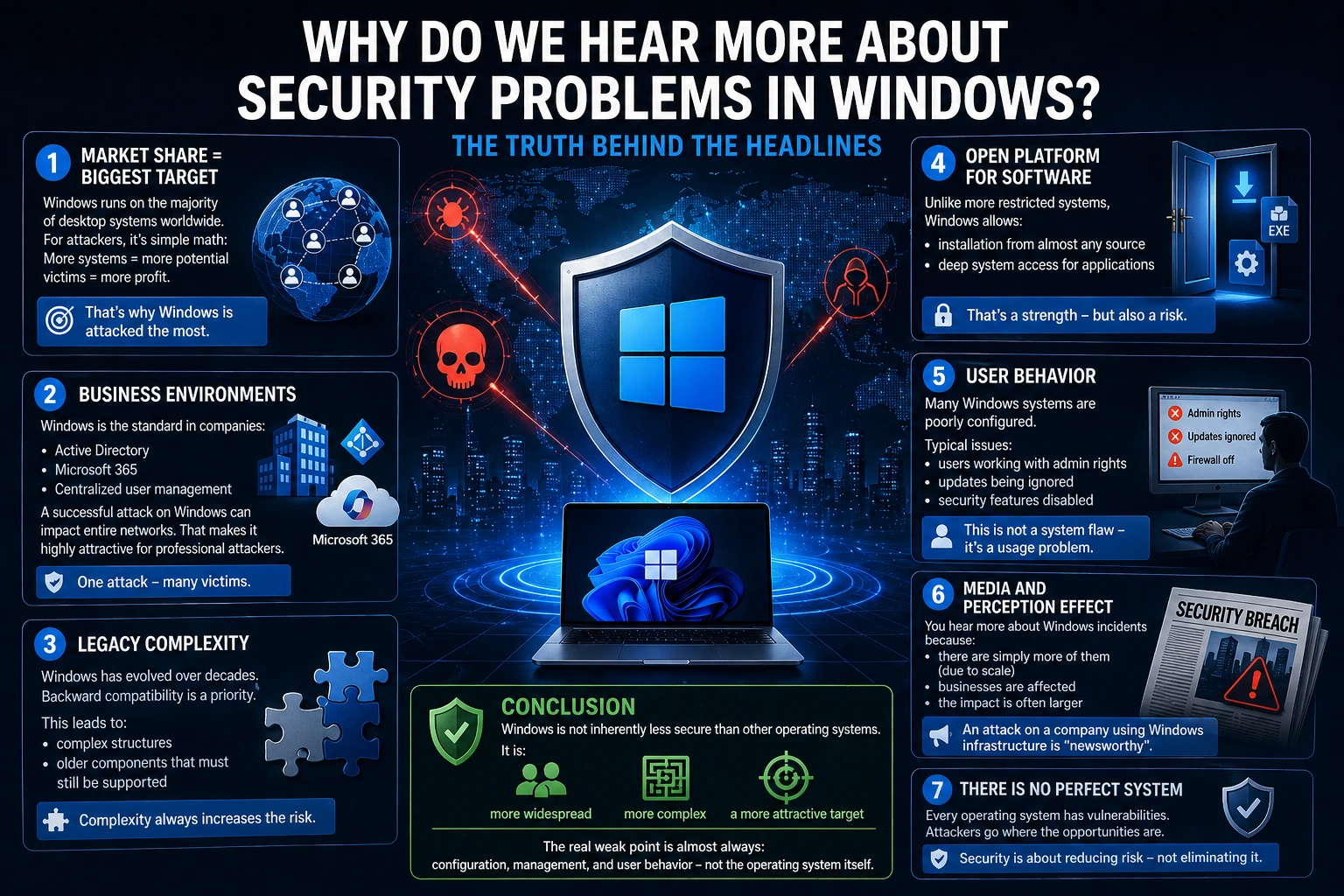
1. Market share = biggest target
Windows runs on the majority of desktop systems worldwide.
For attackers, it is simple math:
More systems = more potential victims = more profit.
That is why Windows is targeted the most.
2. Business environments
Windows is the standard in companies:
- Active Directory
- Microsoft 365
- centralized user management
This means:
A successful attack on Windows can impact entire networks.
That makes it highly attractive for professional attackers.
3. Legacy complexity
Windows has evolved over decades.
Backward compatibility is a priority.
This leads to:
- complex structures
- older components that must still be supported
Complexity always increases the attack surface.
4. Open platform for software
Unlike more restricted systems (e.g. tightly controlled ecosystems),
Windows allows:
- installation from almost any source
- deep system access for applications
That is a strength — but also a risk.
5. User behavior
A critical factor:
Many Windows systems are poorly configured.
Typical issues:
- users working with admin rights
- updates being ignored
- security features disabled
This is not a system flaw — it is a usage problem.
6. Media and perception effects
You hear more about Windows incidents because:
- there are simply more of them (due to scale)
- businesses are affected
- the impact is often larger
An attack on a company using Windows infrastructure is far more visible than an issue on a single private device.
Conclusion
Windows is not inherently less secure than other operating systems.
It is:
- more widespread
- more complex
- a more attractive target
The real weak point is almost always:
configuration, management, and user behavior — not the operating system itself.