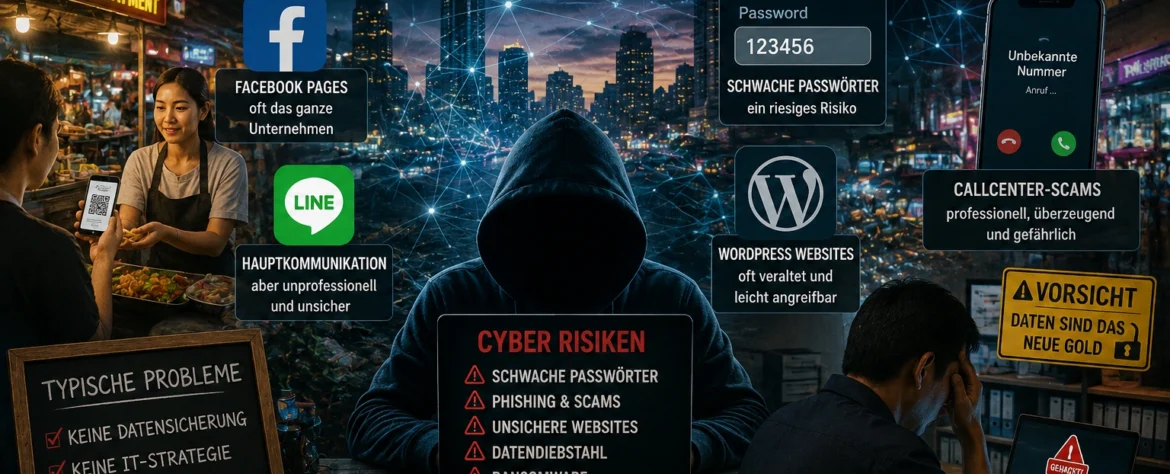
Thailand often appears extremely modern today.
People pay with QR code at street stalls, order food via app and handle banking transactions via smartphone. In some areas, Thailand even appears more digital than Germany.
But behind this modern surface there exists a big problem:
The cybersecurity of many companies and private individuals is alarmingly weak.
And that is exactly what makes Thailand an attractive target for cybercriminals.
Many small companies work digitally – but insecurely
Small and medium-sized enterprises in particular use today:
• Facebook pages
• Line accounts
• cloud services
• online banking
• websites
• remote access
The problem:
Most barely understand the risks.
Company structures often consist of:
• a single password for everything
• private Gmail addresses
• unsecured WordPress websites
• employees without IT knowledge
• old routers
• missing backups
Many believe:
“We are too small to be attacked.”
That is exactly what makes them easy victims.
Facebook is for many companies the actual business
In Europe, Facebook is often only marketing.
In Thailand, however, for many small companies almost the entire business depends on it:
• customer communication
• advertising
• orders
• payment information
• messenger communication
If a Facebook account is hacked or blocked, in some cases the entire business comes to a standstill.
Particularly dangerous:
Many pages are connected to only a single private account.
If this is lost:
• the page is gone
• the advertising is gone
• customer communication is gone
• and sometimes years of work as well
Password security often hardly exists
One of the biggest weaknesses still today:
weak passwords.
Typical examples:
• 123456
• companyname2025
• phone numbers
• simple words
• identical passwords for multiple services
Even worse:
Passwords are often:
• sent via Line
• written down on paper
• shared with employees
• never changed
Many companies also have no:
• password manager
• access protection
• two-factor login
• security concept
WordPress sites are often ticking time bombs
A huge problem in Thailand:
insecure websites.
Especially WordPress installations are often:
• not updated for years
• operated with insecure plugins
• poorly configured
• used without a firewall
Many website owners only notice something when:
• Google blocks the site
• malware is distributed
• visitors see warning messages
• spam pages appear
• or suddenly pornography links appear
Often the malware has already been in the system unnoticed for months.
Call center scams are exploding in Southeast Asia
Almost everyone in Thailand now knows fraudulent calls.
Typical methods:
• alleged police
• fake bank employees
• parcel services
• tax authorities
• electricity providers
The goal is almost always:
• money transfers
• access data
• personal information
Many victims lose:
• their entire savings
• company accounts
• or access to important accounts
The professional organization of some scam networks is now alarmingly high.
AI makes the situation even more dangerous
Through artificial intelligence, fraud attempts are becoming increasingly realistic:
• fake voices
• perfect translations
• realistic-looking websites
• manipulated videos
• automated phishing emails
In the past, scam emails were often immediately recognizable.
Today, that is significantly more difficult.
Older people and small companies in particular are at risk.
Many people trust technology blindly
Another problem:
Many users automatically believe:
“If it is online, it must be secure.”
But many do not even know:
• where their data is stored
• which apps have access
• how cloud systems work
• or what risks public WLAN networks have
Free apps in particular often collect enormous amounts of personal data.
Thailand is digitally fast – but security is lagging behind
Thailand is developing extremely quickly technologically.
But security awareness is developing much more slowly.
This creates a dangerous combination:
• high digitalization
• low IT knowledge
• weak security structures
• and enormous dependence on smartphones and social media
Conclusion
Thailand’s digital world is modern, fast and impressive.
But behind this modern surface there are massive security problems that many people only notice when it is already too late.
Cybercrime today no longer affects only large corporations.
Affected are:
• small companies
• restaurants
• hotels
• online shops
• private individuals
• and even simple Facebook pages
And that is exactly why cybersecurity in Thailand will no longer be optional in the future — but vital for survival.