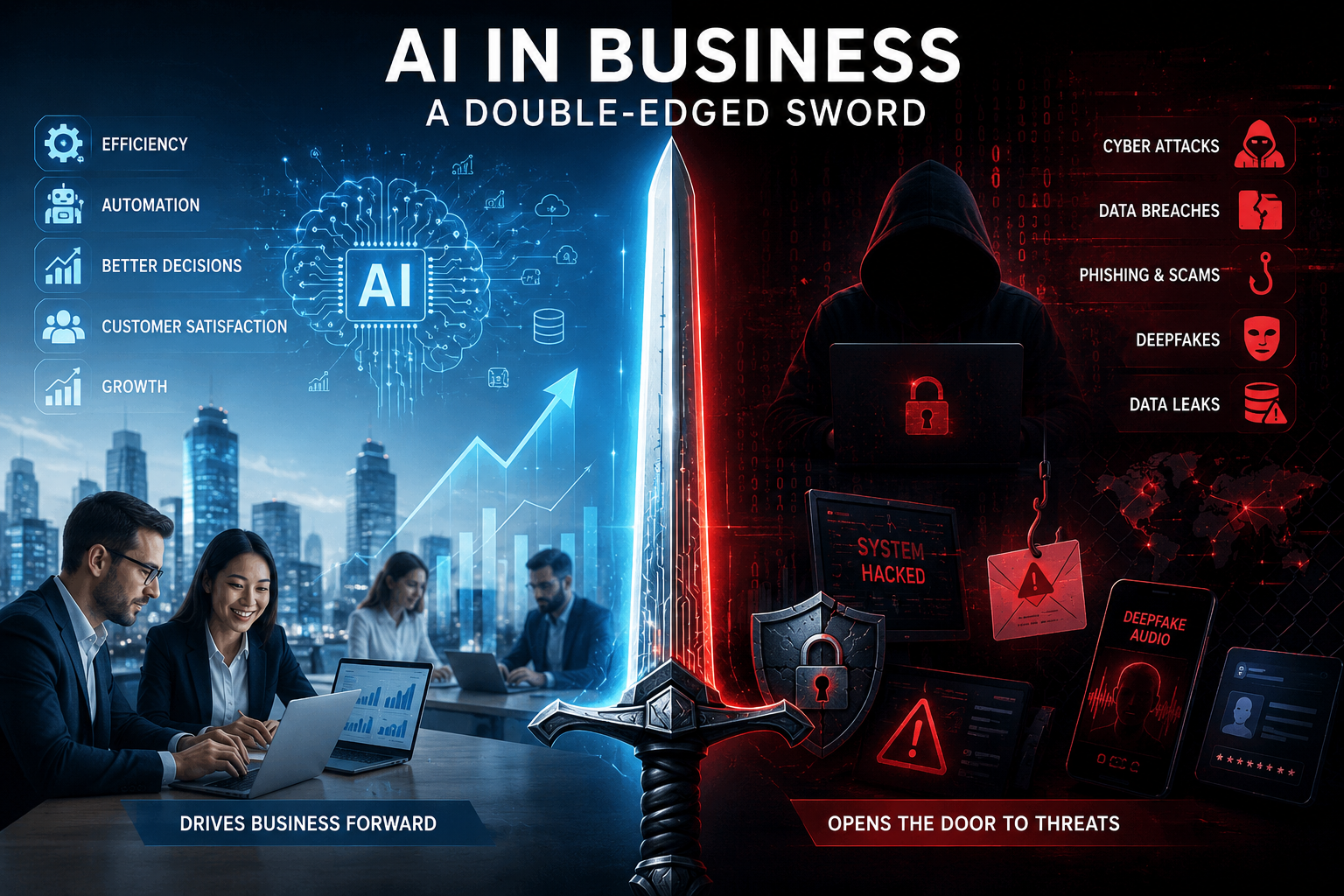
Using artificial intelligence (AI) in business is like using a double-edged sword. On one side, AI helps companies work faster, save money, and improve productivity. On the other side, if AI is not used safely, it can create new opportunities for cybercriminals.
AI is no longer just a popular topic. It has become an important business tool. Companies of all sizes use AI to automate routine work, improve customer service, analyze data faster, and make better business decisions. Today, most companies are no longer asking if they should use AI. Instead, they are asking how quickly they can start using it.
There is a good reason for this excitement. AI offers many real business benefits. But like every powerful technology, it also brings new risks. If companies do not manage AI properly, the same technology that helps them grow can also help cybercriminals attack them.
AI Is Changing the Way Businesses Work
AI is changing almost every part of modern business.
Marketing teams use AI to write articles, advertisements, and social media posts. Software developers use it to write computer code. Customer service teams use AI chatbots to answer customer questions 24 hours a day. Finance departments use AI to predict future business trends, while logistics companies use it to find the fastest and cheapest delivery routes.
The benefits are clear.
AI helps companies save time, reduce costs, increase productivity, and make better decisions based on data.
Cybersecurity teams also use AI. It can examine millions of events every second and quickly find unusual or suspicious activity that people or traditional security software might miss.
It is easy to understand why AI has become such an important business tool.
Every new technology brings new risks.
Every major technology has changed the way businesses work. But every new technology has also created new security problems.
The internet made communication easier but also created cybercrime.
Cloud computing gave businesses more flexibility but introduced new security challenges.
AI is following the same path.
As companies connect AI to more business systems, they also create more ways for attackers to enter their networks. Many companies are adopting AI faster than they are protecting it, and this creates unnecessary risks.
Cybercriminals Are Using AI Too
Many people think AI only helps businesses.
Unfortunately, criminals are using the same technology.
Today, phishing emails are much more convincing than before. AI can write professional emails without spelling mistakes and can personalize every message using information from LinkedIn, company websites, or social media.
AI can also copy a person’s voice or create realistic fake videos, known as deepfakes.
In one well-known case, an employee joined what looked like a normal video meeting with company executives. In reality, everyone else in the meeting was created by AI. The employee believed the meeting was real and transferred about US$25 million to criminals.
This shows how dangerous AI-powered scams have become.
Shadow AI – A Risk Inside the Company
Not every AI risk comes from hackers.
Sometimes the biggest risk comes from employees who simply want to work faster.
Many employees copy company information into public AI tools without thinking about the consequences. They may upload contracts, customer information, financial reports, source code, or confidential business plans.
This is called Shadow AI.
Once confidential information is uploaded to a public AI platform, the company may lose control over where the data is stored, who can access it, or how long it will remain there.
For companies working with customer information, financial data, healthcare records, or valuable intellectual property, this can become a serious security and legal problem.
AI Systems Can Also Be Attacked
AI itself can become a target.
Attackers may try to change the data used to train AI systems so they make wrong decisions. They may try to steal expensive AI models or trick AI systems into ignoring security rules.
As AI becomes connected to email systems, databases, accounting software, and other business applications, the possible damage from these attacks becomes much greater.
The smarter AI becomes, the more attractive it becomes to cybercriminals.
Security Must Come First
Many companies focus on installing AI but forget to think about security.
This is like installing a high-quality alarm system while leaving the front door open.
Companies need clear rules about:
- Which AI tools employees may use.
- What company information may be shared with AI.
- Who is allowed to use AI systems.
- How AI systems are monitored and protected.
International standards such as the NIST AI Risk Management Framework, ISO/IEC 42001, and the EU AI Act can help companies build these rules.
AI security is not only the responsibility of the IT department. Company management must also be involved.
People Are Still the Best Protection
Technology alone cannot stop cybercrime.
Employees need regular training so they understand both the benefits and the risks of AI.
Companies should combine employee awareness, strong passwords, access controls, continuous monitoring, and human supervision with AI technology.
AI should help people make better decisions—not replace human thinking.
The companies that succeed will be those that combine smart technology with smart people.
The Cost of Ignoring AI Security
A successful cyberattack can cause much more than technical problems.
It can expose confidential customer information, stop business operations, damage the company’s reputation, lead to legal action, and result in large financial losses.
Winning back customer trust after a security incident can take many years.
Although investing in AI security and governance costs money, recovering from a cyberattack usually costs much more.
Conclusion
Artificial intelligence is one of the most powerful business tools ever created.
When used responsibly, it helps companies become more efficient, more innovative, and more competitive.
But if AI is introduced without proper security, it can create serious risks.
The goal is not to fear AI or avoid using it. The goal is to use AI wisely, securely, and with clear rules from the beginning.
The companies that will be most successful in the future are not necessarily those using the most AI.
They will be the companies that use AI in the safest and most responsible way.
In today’s digital world, success is not only about how fast you adopt new technology. It is also about how well you protect your business, your customers, and your valuable information.