Today, when people talk about “AI,” they usually mean ChatGPT, Copilot, Claude, Grok, or DeepSeek. Strictly speaking, however, these are primarily Large Language Models (LLMs) or AI assistants built on them.
They can work with text, images, audio, and code. They generate content, analyze information, write software, and hold conversations. But an LLM is not a robot, not general artificial intelligence, and it does not understand the world the way humans do. It identifies patterns, probabilities, and relationships.
Modern AI is impressive—but it remains highly specialized.
From Digital AI to Physical AI
Most AI today is digital. ChatGPT writes; Copilot supports productivity; Claude analyzes documents; and other systems assist with research and coding.
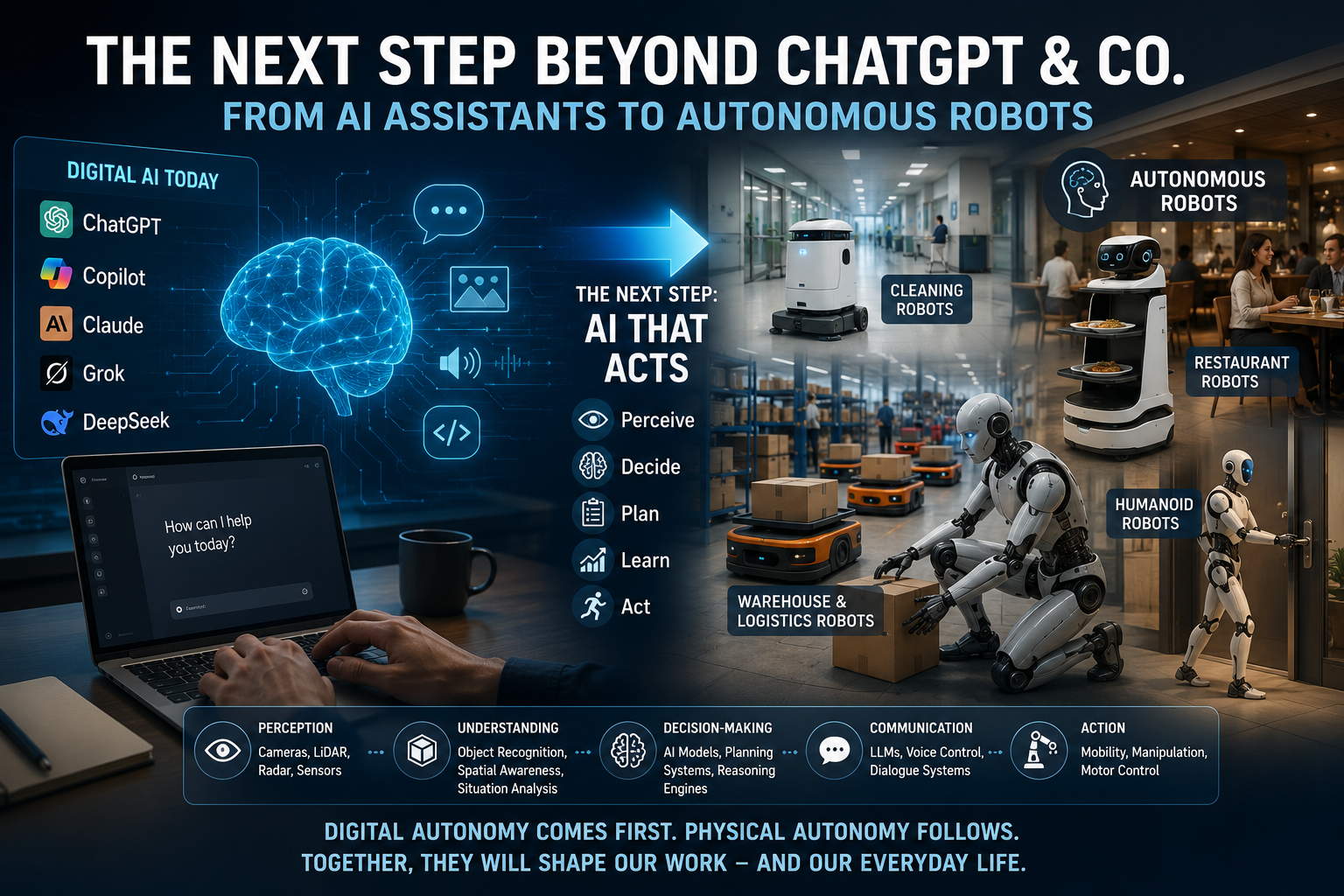
The next major step is AI that doesn’t just respond—it acts. These systems can perceive their environment, make decisions, plan tasks, learn from experience, and operate independently. At that point, we move beyond assistants to autonomous systems.
This Is Already Happening
Autonomous machines are already in use:
- Cleaning robots operate in hospitals, airports, hotels, and shopping centers. Most rely on sensors, maps, and predefined navigation rules rather than true intelligence.
- Restaurant robots can deliver food and avoid obstacles but generally follow fixed routines.
- Warehouse and logistics robots are more advanced, handling transport, route optimization, and coordinated operations with partial autonomy.
- Humanoid robots, developed by companies such as Tesla, Figure AI, Boston Dynamics, and Agility Robotics, are being trained to perform human tasks like carrying objects, using tools, opening doors, operating equipment, and assisting people.
What Is Changing Technologically?
Traditional machines followed fixed instructions.
Modern autonomous robots combine the following:
- Perception: cameras, LiDAR, radar, touch and ultrasonic sensors
- Understanding: object recognition, spatial awareness, situation analysis
- Decision-making: AI models, planning systems, reasoning engines
- Communication: LLMs, voice control, dialogue systems
- Action: mobility, manipulation, and motor control
This is far more than simply a “chatbot with arms.”
A Common Misconception
Many people equate AI with LLMs, but AI is much broader.
Examples of AI that do not rely on language models include:
- Facial recognition
- Spam filtering
- Recommendation engines
- Fraud detection
- Computer vision
- Autonomous driving
- Predictive maintenance
- Medical diagnostics
LLMs are only one part of the AI landscape.
What Comes First?
Many expect autonomous robots to arrive next. In reality, AI agents will likely come first.
These digital systems can already:
- Manage schedules
- Answer emails
- Conduct research
- Operate software
- Execute business processes
Physical robots will follow, but more slowly because the real world is unpredictable. Humans instantly recognize hazards, obstacles, emotions, and unusual situations—tasks that remain extremely difficult for machines.
That is why digital AI is advancing much faster than physical autonomy.
Which Jobs Will Be Affected First?
The first major impact will not be on manual labor but on digital knowledge work, including
- Basic customer support
- Standard content creation
- Routine research
- Data analysis
- Administrative tasks
Physical routine jobs are likely to be affected later.
The long-term future is not humans or AI, but humans working together with AI and robotics.
Conclusion
ChatGPT and similar tools are not the end goal. They are the user interface of a much larger technological shift.
The real transformation begins when AI stops simply answering questions and starts acting independently.
Digital autonomy comes first. Physical autonomy follows. And when that happens, it won’t just change how we work—it will reshape everyday life.