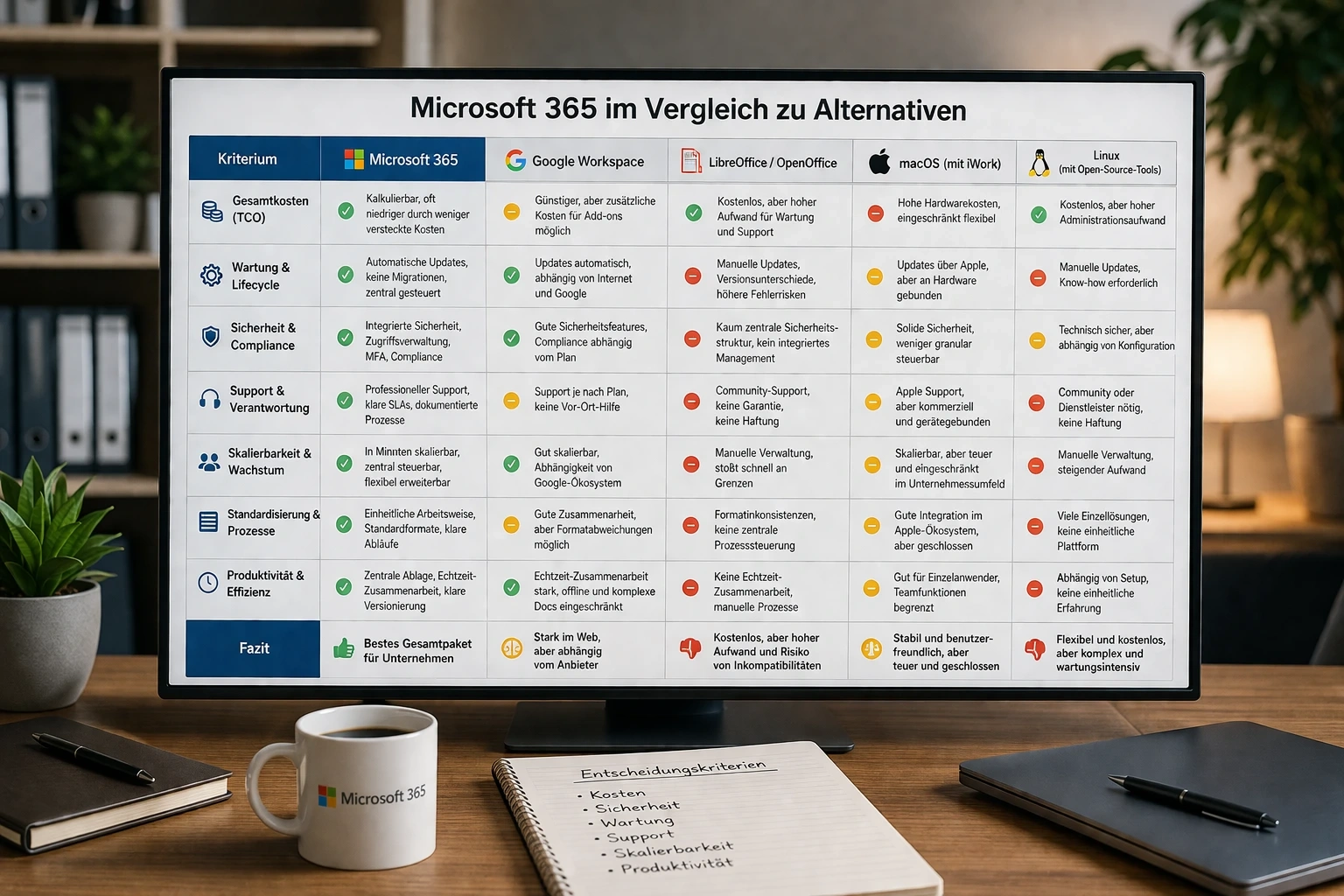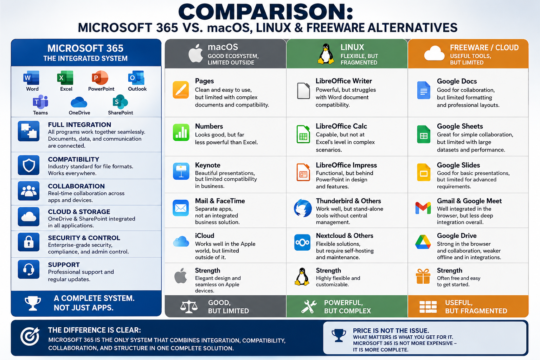

When making the decision at management level, it is no longer about detailed features, but about cost structure, risk, maintenance effort, and operational reliability. This is exactly where Microsoft 365 clearly separates itself from macOS solutions, Linux setups, and freeware.
1. Total Cost of Ownership (TCO)
The most common mistake is to look only at licensing costs. Microsoft 365 may appear more expensive at first glance because it involves an ongoing fee. In reality, total costs are often lower.
Why?
Because many hidden costs arise with alternatives:
- Time lost due to incompatible documents
- Additional effort for manual coordination
- Extra tools for email, cloud storage, meetings
- Internal or external IT support for setup and maintenance
Microsoft 365 combines everything into one system. Fewer interfaces mean fewer points of failure—and therefore lower costs.
With Linux or freeware, the software itself may be free, but operating costs rise: setup, maintenance, training, and support all cost time or money. This is regularly underestimated.
2. Maintenance and Lifecycle Management
Microsoft 365 removes a large part of traditional IT workload:
- Automatic updates
- No major version jumps or migrations
- Centrally manageable systems
- Consistent versions for all users
With traditional installations or freeware, it looks different:
- Updates must be planned and tested
- Different versions across the company
- Manual intervention required
- Higher risk of incompatibilities
Linux is stable, but maintenance remains manual work. macOS is simpler, but strongly tied to Apple and less flexible in a business environment.
3. Security and Risk Management
This is where it becomes business-critical.
Microsoft 365 offers:
- Integrated security mechanisms
- Central user and access management
- Multi-factor authentication
- Threat detection and automated responses
The key point: security is part of the system, not an optional add-on.
Alternatives:
- Freeware: little or no central security structure
- Linux: technically secure, but dependent on configuration and expertise
- Apple: solid, but less granular control in enterprise environments
The real risk lies not in the software itself, but in misconfiguration and lack of control. Microsoft reduces exactly this risk.
4. Support and Responsibility
A point often ignored: Who is responsible when something stops working?
With Microsoft 365 you have:
- Clearly defined support structures
- Documented processes
- Reliable updates and fixes
With freeware:
- Community support
- No guaranteed response times
- No liability
Linux environments can be run professionally—but only with sufficient expertise or an external service provider.
In short:
Microsoft = clear point of contact
Freeware = self-responsibility
5. Scalability and Growth
A business does not remain static. Systems must grow with it.
Microsoft 365 is designed for this:
- New users integrated within minutes
- Permissions centrally managed
- Services flexibly expandable
Alternatives quickly hit limits:
- Manual user management
- Different tools without central control
- Increasing administrative effort
This leads to a classic problem: as growth increases, complexity rises disproportionately.
6. Standardization and Processes
Crucial in practice.
Microsoft 365 provides:
- Consistent ways of working
- Standardized documents
- Clear workflows
Alternatives often lead to:
- Different tools in use
- Individual workflows
- Lack of structure
The result: inefficient processes and workflows that are hard to control.
7. Productivity as an Economic Factor
The biggest cost factor is not software—but working time.
If employees must:
- Search for documents
- Compare versions
- Solve avoidable problems
…then it directly costs money.
Microsoft 365 reduces exactly these friction losses:
- Central storage
- Real-time collaboration
- Clear version control
That is not convenience—it is efficiency.
Conclusion
The decisive question is not:
“Which software is free?”
But:
“Which solution causes the lowest total cost while delivering maximum stability?”
And here the situation is clear:
- Freeware saves license costs but increases operational effort
- Linux offers flexibility but requires expertise
- macOS is stable but limited in business contexts
Microsoft 365 delivers the best overall package of:
- Predictable costs
- Low maintenance effort
- High security
- Clear structure
This is not a matter of preference but of economic efficiency and risk minimisation.